Gowning
Whether compulsory, location, sequence, duration and the time clock's position guide the time assessment.
Brazilian Employment Law · Anápolis/GO
Clean areas, production, quality, maintenance, laboratories and pharmaceutical chemicals involve different procedures and exposures. Assessment must connect compulsory changing, access records, timekeeping, shifts and occupational health.
General legal information. Any entitlement depends on the facts, records, collective rules and, where applicable, expert evidence.
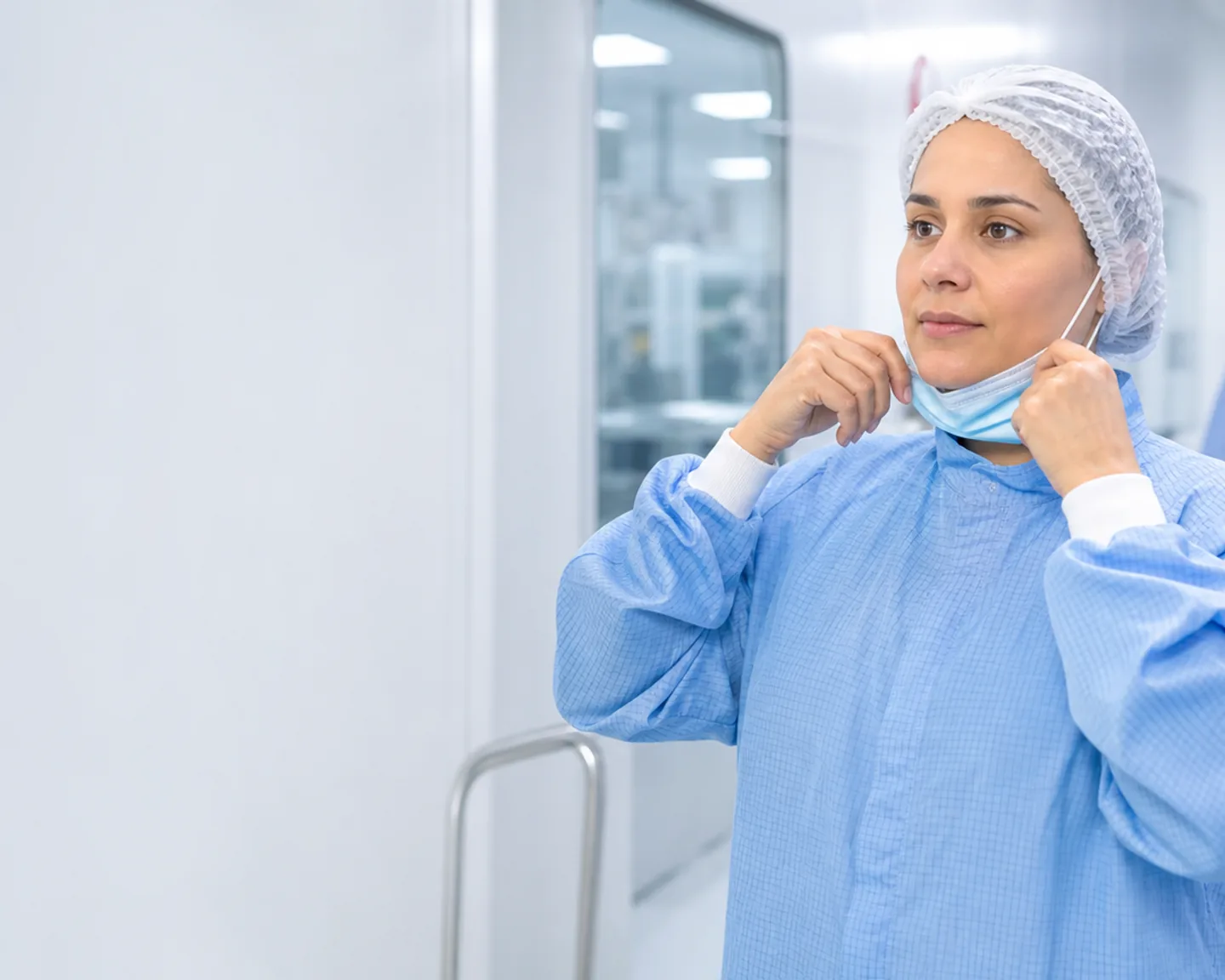
Gowning and access
Compulsory changing, hygiene barriers, records and actual duration
OAB/GO No. 64.591
Professional registration in Goiás, Brazil
Shifts and health
Working hours, agents, absences and technical documentation
Time at the employer's disposal
The procedure must be analysed in detail: where it takes place, why it is required, how long it lasts and how it relates to clocking in and out.
As a rule, the CLT excludes changing time where changing at the company is not compulsory. In controlled areas, however, a requirement to change and pass hygiene barriers inside the premises may raise the issue of time at the employer's disposal.
The conclusion depends on actual duration, the time clock's location, tolerances, access records and the collective agreement. A fixed duration cannot simply be presumed for all departments or shifts.
Good manufacturing practice procedures, standard operating procedures (POPs in Brazil), training and company logs may explain the requirement and operational sequence, without replacing evidence of each employee's working hours.
Situations we assess
Assessment respects the differences between production, laboratories, quality, logistics and support areas.
Areas of assessment
The list helps identify relevant issues, but cannot establish that a particular payment is due without examining the case.
Whether compulsory, location, sequence, duration and the time clock's position guide the time assessment.
Turnstiles, logs, systems, batches and POP standard operating procedures may be compared with timecards.
Hours, supplement, shorter statutory night hour, extended night work and the collective agreement must be checked.
Product, concentration, exposure route, ventilation and protection require technical and regulatory assessment.
Activity, material handled, containment and classification must be established.
Dermatitis, allergies and other diagnoses require an individual history, causal assessment and medical documentation.
Changing, shift handovers, meals and extensions to working hours are reconstructed from the records.
Cleaning, maintenance and support may require documents from the provider and industrial client.
Initial advice identifies the facts, periods and records that need checking.
Employment time limits
As a general rule, the Brazilian Constitution allows two years after the contract ends to bring proceedings, and limits recovery to entitlements from the five years before the claim is filed.
2 years
General period from the end of employment for bringing an employment claim.
5 years
General reach of entitlements preceding the claim, subject to the particular circumstances.
For occupational illness, preserve examinations, dates of department changes, absences and benefits. These elements may affect causation and time limits.
Organising documents
You do not need every document at first contact. The aim is to identify what exists and what will need to be requested.
Time record summaries, rotas, turnstiles, hygiene barriers, logs and department entry records.
Standard operating procedures (POPs), training and gowning or de-gowning instructions, where available.
Role, shifts, supplements, overtime and related payments.
FDS safety data sheets, task descriptions, instructions, batches and department history, without disclosing trade secrets.
ASO occupational health certificates, examinations, medical certificates, CAT accident notifications, PGR risk management programme, expert reports, PPE and absence records.
Agreements applicable to the company, role, location and period.
Transparency
The activity, sector or an isolated impression cannot replace assessment of facts and evidence.

Who will assist you
A Brazilian lawyer specialising in Employment Law and Procedure and Social Security Law, with a background in Law, Accounting and Economics.
The lawyer responsible is registered with OAB/GO under No. 64.591 and specialises in Brazilian Employment Law and Procedure and Social Security Law. Assessment connects working hours, industrial procedures, agents and social security implications without prejudging technical findings.
Responsible professional: Alex Rodrigues Alves
OAB/DF nº 46.260 | OAB/GO nº 64.591 | OAB/SP nº 508.634 | OAB/MG nº 230.667 | OAB/ES nº 44.334 | OAB/PR nº 136.193
Frequently asked questions
General answers for guidance. Conclusions depend on the records and circumstances of each contract.
Not automatically. Where changing is compulsory, must take place at the company and keeps the employee subject to the employer's procedure, time at the employer's disposal may be at issue. Duration, records, tolerances and collective agreements must be examined.
No. The changing location, whether changing is compulsory, actual duration, ability to arrive in uniform, monitoring and total working hours are relevant. The uniform alone does not determine the outcome.
Yes. Turnstiles, access systems, production logs and procedures may help reconstruct working hours, provided they can be linked to the worker and routine.
Not because of the sector alone. Chemical or biological agents, nature of contact, controls, PPE and classification under NR-15 must be established, often through technical evidence.
It may involve a night work supplement, a shorter statutory night hour and work extending beyond the night period, depending on the hours, occupational category and collective agreement. Timecards and payslips must be compared.
Only in the statutory circumstances associated with an occupational accident or disease, following assessment of the diagnosis, causal link, benefit and dates. Illness alone does not guarantee protected employment.
WhatsApp messages can be received in different languages. Telephone calls are available in Portuguese, English and Spanish.
Initial contact
Tell us the company, department, role, shift, gowning sequence, time clock location, known agents and any diagnosis or absence from work.
Do not send identity documents, bank details, medical examinations or detailed intimate accounts through the initial form. If assessment proceeds, the firm will indicate an appropriate channel.
Online legal advice in Anápolis and throughout the state of Goiás, with in-person appointments in Ceilândia Sul, Brasília/DF, Brazil.
QNM 01 Conjunto H, Lote 40, Sala 102, Ceilândia Sul, Brasília/DF, CEP 72215-018
Monday to Friday, 8 am to 5 pm.
Official sources and related pages
Legislation and institutional guidance