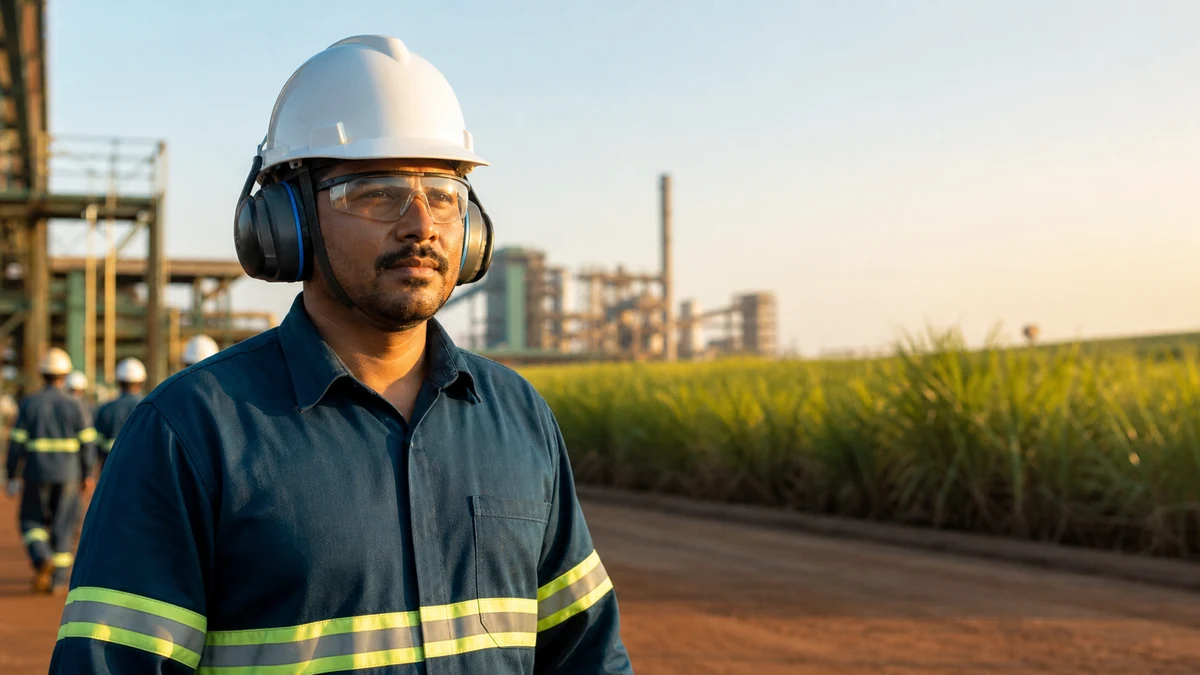
Heat and preventive measures
Technical assessment, metabolic effort, working hours, season and control measures must be examined under the applicable standards.
Brazilian Employment Law · Goianésia/GO
In the fields and sugar and bioenergy industry, the conclusion depends on the actual activity, heat assessment, breaks, remuneration method, shifts and type of contract.
General legal information. Any entitlement depends on the facts, records, collective rules and, where applicable, expert evidence.
Sugar and bioenergy sector
Fields, industry, maintenance, transport and harvests
OAB/GO No. 64.591
Professional registration in the state of Goiás, Brazil
Online advice
Documents and an initial meeting by digital means
Occupational heat
Safety regulations require assessment and preventive measures. Classification as unhealthy work follows its own criteria and must take account of the regulations in force during the relevant period.
NR-9 addresses the assessment and control of occupational heat exposure. In 2026, Brazil's Ministry of Labour updated corrective measures for outdoor activities, including access to cooler areas allowing thermal recovery when limits are exceeded.
NR-31 also requires breaks for rural activities necessarily performed standing or involving muscular overload, as defined in the PGRTR. A collective agreement may specify duration, distribution and other sector conditions.
The TST's Orientação Jurisprudencial 173 rules out a supplement for sun exposure alone. Heat above technical limits must be considered with attention to the employment period and changes to regulatory standards; entitlement must therefore not be promised before technical assessment.
Situations we assess
The same plant encompasses different environments and routines. Classification must follow the actual activity.
Areas of assessment
The list helps identify relevant issues, but cannot establish that a particular payment is due without examining the case.
Technical assessment, metabolic effort, working hours, season and control measures must be examined under the applicable standards.
Activities performed standing or involving muscular overload must provide for breaks and suitable organisation, as defined in the PGRTR.
Contact with pesticides, fertilisers and industrial products requires identification of the agent, exposure method and protection adopted.
Production records, payslips, rest periods, working hours and the collective agreement must be compared to identify any discrepancies.
Waiting, preparation, internal travel and equipment changes depend on company control and the actual circumstances.
Alternating working hours may attract the specific constitutional working time regime, subject to valid collective bargaining.
Normal expiry, early termination and successive contracts have different effects and must be distinguished.
Machinery, tools, repetitive effort and back problems require medical documentation and assessment of occupational causation.
Initial advice identifies the facts, periods and records that need checking.
Employment time limits
As a general rule, the Brazilian Constitution allows two years after the contract ends to bring proceedings, and limits recovery to entitlements from the five years before the claim is filed.
2 years
General period from the end of employment for bringing an employment claim.
5 years
General reach of entitlements preceding the claim, subject to the particular circumstances.
For successive harvest contracts, dates and limitation effects must be checked separately. Do not assume every harvest has the same starting point.
Organising documents
You do not need every document at first contact. The aim is to identify what exists and what will need to be requested.
All available contracts, amendments and termination documents.
Quantity records, payment criteria, supplements and their effects on other entitlements.
Working hours, rotas, waiting and travel associated with the working routine.
Risk management documents and agreements applicable to the period.
Actual role, work location, equipment, working hours and lawful work communications.
ASO occupational health certificates, medical certificates, examinations, CAT accident notifications and social security history where related to the case.
Transparency
The activity, sector or an isolated impression cannot replace assessment of facts and evidence.

Who will assist you
A Brazilian lawyer specialising in Employment Law and Procedure and Social Security Law, with a background in Law, Accounting and Economics.
The lawyer responsible is registered with OAB/GO under No. 64.591. Training in employment law and accounting assists in reading harvest contracts, production records, payslips, working hours and occupational safety documents together.
Responsible professional: Alex Rodrigues Alves
OAB/DF nº 46.260 | OAB/GO nº 64.591 | OAB/SP nº 508.634 | OAB/MG nº 230.667 | OAB/ES nº 44.334 | OAB/PR nº 136.193
Frequently asked questions
General answers for guidance. Conclusions depend on the records and circumstances of each contract.
Sun exposure alone does not allow an automatic conclusion. Occupational heat, preventive measures and any supplement have distinct regulatory bases. The period, activity, heat sources, technical assessment and applicable regulations must be considered.
NR-31 requires breaks for activities that must be performed standing and those involving muscular overload, as defined in the Rural Work Risk Management Programme. Their duration and distribution may also be covered by a collective agreement.
Yes, but remuneration and its effects on other entitlements must comply with legislation and the collective agreement. Production records, payslips and working hours must be checked together.
No. Fixed-term contracts have their own rules. Outstanding wages, proportional holiday pay and the proportional thirteenth-month salary remain relevant, but notice pay and the 40% FGTS penalty do not automatically follow from normal expiry.
They may. Dates, gaps between contracts, permanent or seasonal activity and the method of hiring must be examined contract by contract.
Not by itself. Suitability for the agent, provision, training, replacement, supervision and actual effectiveness must be assessed. In some areas, the regulation or case law provides for specific consequences even where PPE is supplied.
Related content
Brazilian employment law
Understand how to check working hours, heat, breaks, production-based pay and harvest contracts when working at mills in Goianésia and the surrounding area.
6 August 2026
WhatsApp messages can be received in different languages. Telephone calls are available in Portuguese, English and Spanish.
Initial contact
Tell us the role, period, whether it was a harvest contract, working environment, working hours and your main question.
Do not send identity documents, bank details, medical examinations or detailed intimate accounts through the initial form. If assessment proceeds, the firm will indicate an appropriate channel.
Online advice for Goiás and in-person appointments in Ceilândia Sul, Brasília/DF, Brazil.
QNM 01 Conjunto H, Lote 40, Sala 102, Ceilândia Sul, Brasília/DF, CEP 72215-018
Monday to Friday, 8 am to 5 pm.
Official sources and related pages
Legislation and institutional guidance